
Cosmetics came into being much earlier than one imagines; for thousands of years people have been taking care of themselves for a healthy appearance. Times change and needs require an appropriate response. We are Studio Concept and help cosmetics companies communicate their value, the secret lies in a targeted approach starting with SWOT analysis.
Indice
What is SWOT analysis and what is it for?
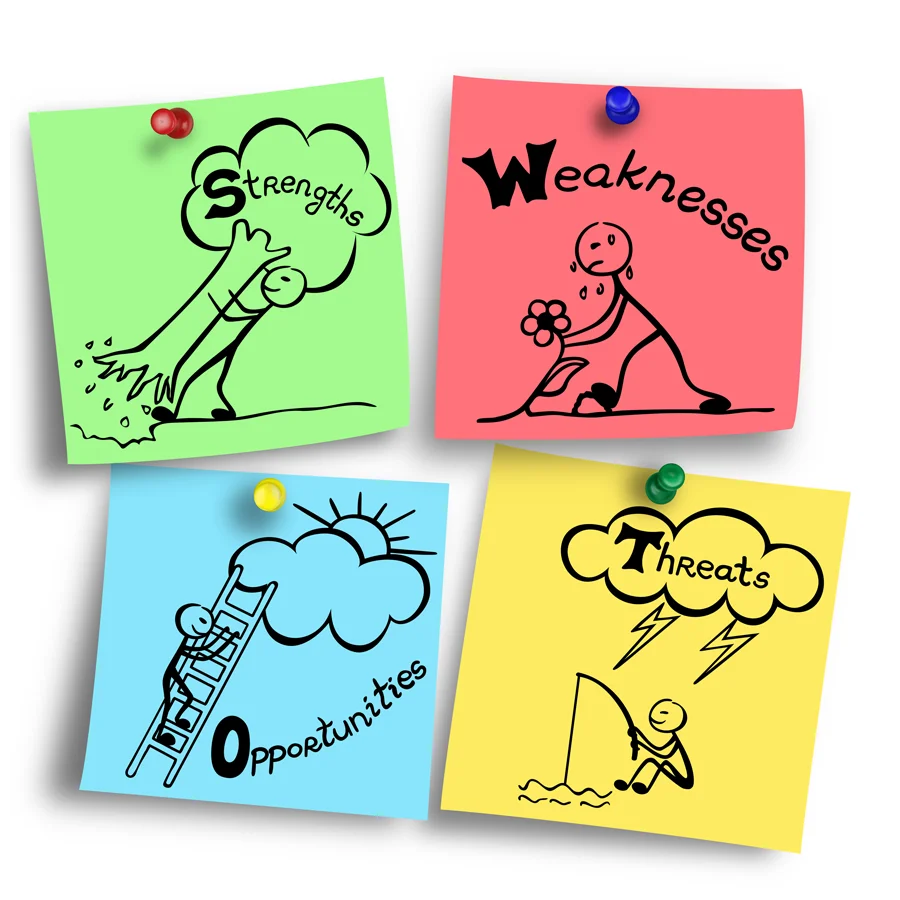
Strengths, Weaknesses, Opportunities, Threats are the terms that make up the acronym. The pivot of analysis lies in an approach aimed at taking a real snapshot of the production reality, the aim being the obvious one of a business strategy: you need to know where you are in order to decide which direction you want to go. Although this is more commonly referred to as analysis, it is actually a matrix decision-making process. The success of the method lies in its history; it stems from the ideas of Albert Humphery of Stanford University who coined it in the 1970s.
How is a SWOT analysis performed? Much depends on the strategy in use in the team, with some opting for the formal matrix and others preferring an informal meeting for an organic discussion. What is needed is an overview and the will to find new ideas and solutions. Analysing internal sources is just as useful as considering customer opinions; the effectiveness of the method relies on proactive openness on the part of all participants. Assessing strengths and weaknesses but also proposing and evaluating the best ideas are ingredients of an effective SWOT analysis.
How many parameters make up a SWOT?
The four points of the analysis constitute a well-defined 2 x 2 matrix: two are the positive elements and two are the negative ones, the classification also allows the division into internal and external factors. Strengths (Strengths) and Weaknesses (Weaknesses) are in fact intrinsic elements of the company’s reality, Opportunities (Opportunities) and Threats (Threats) on the other hand belong to the comparison with the external context. The method is particularly suited to the analysis of the cosmetics industry, the large figures characterising it necessitating an effective approach to the analysis of positive and negative factors. Here is a more detailed example.
Contact us for more information on our services
Strengths in the Cosmetics Industry
The growth rate is +4.4% on a global scale, the figures exceed USD 350 billion but the outlook looks towards USD 1 trillion by 2030. Growth is underpinned by a strong focus on research, cosmetics being one of the most active sectors in this respect. The volume depends on powerful marketing, it is virtually impossible to forget the most effective campaigns. Another plus point is the abundance of products, every customer can have a solution to meet their needs. Finally, there is the adaptability of a fluid industry that can mould itself to trends.
Weaknesses in the cosmetics industry
Counterfeiting will weigh in at $75 billion by 2025, constituting a major scourge for the industry. The abundance of products unfortunately means that there is a more or less controlled use of harmful ingredients, here things change depending on national regulations. The environmental impact of the cosmetics industry is a negative factor, the harmful ingredients are compounded by the use of plastic packaging. There is unfortunately also the pollution of models, cosmetics too often impose beauty standards far removed from reality: body shaming is one of the effects. Misleading advertising takes its toll, it causes losses to the whole industry.
Opportunities in the cosmetics industry
Already the present offers a panel of tools that can enhance image and production in cosmetics, the sector is particularly dynamic in response to technological adaptations: one can think of the impact of AI but also of nanotechnology. Sustainability is one of the useful and viable avenues of Industry 4.0, optimising its practices is an opportunity to save money and resources. Then there is the potential for market expansion, Asia but also Africa and South America are emerging areas with interesting prospects. There is an appetite for health and wellness, consumer trends are going in this direction and this is where cosmetics has a role to play. E-commerce is the queen opportunity in an increasingly connected world.
Threats in the Cosmetics Industry
The SWOT analysis concludes with obstacles to be avoided. Raw materials that are not always available, but also the burden of cosmetics waste are factors that lead the industry to deal with the environment. The current inflation has a major impact on prices and shrinking consumption. Safety is a constant threat in the industry, adverse events can be a serious problem for customers and companies. Then there is the impact of laws, cosmetics companies are the target of lawsuits and strict national laws.